
Loops between Northeast Asia and Australia are showing weak growth compared to other lanes, Drewry said, with a 12-month rolling average of 3 percent volume growth as of the end of July. Without withdrawing services completely, carriers instead are relying on the quickest option to reduce capacity: canceling voyages and rolling cargo onto subsequent trips.
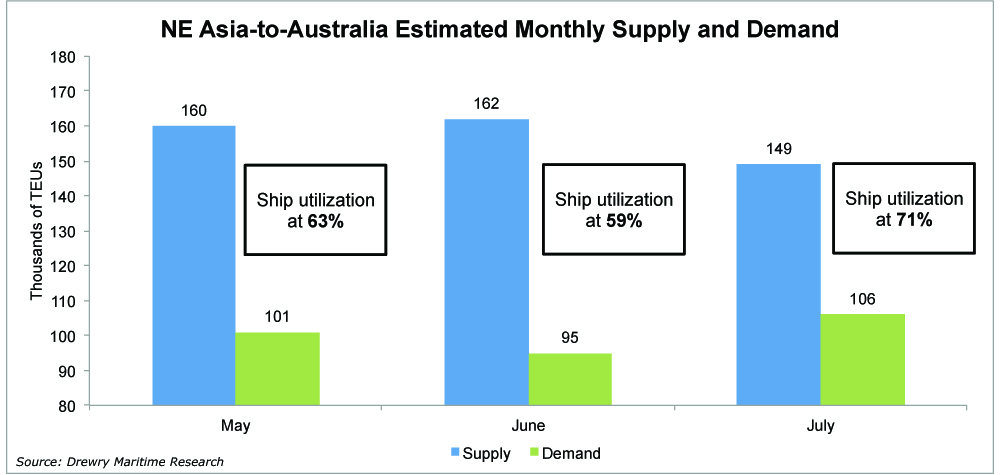 Ship utilization was 71 percent in August in the Asia-Australia trade.
Southbound ship utilization on the lane was 63 percent in May, but fell to 59 percent in June. In July, five canceled voyages helped reduce southbound capacity, boosting utilization 8 percentage points to 71 percent, Drewry said in its latest edition of Container Insight Weekly. Though volume data is not available for August and September, the pattern of sailing cancellations continued, with four reported in August and two in September.
The tighter capacity resulted in higher spot rates, Drewry said, which jumped 7.3 percent from July to August. Prices registered at an average of $1,680 per 40-foot container in August.
"Rates are expected to continue to rise moderately as demand picks up in the coming months, but unless carriers can significantly improve utilization, carriers should not expect rates to soar,” Drewry said.
In July, southbound container traffic from Northeast Asia to Australian ports totaled 105,500 TEUs, Drewry said, up 0.8 percent year-over-year. Backhaul traffic has grown 2.6 percent year-to-date, according to Container Trade Statistics data.
Demand is expected to grow through October; soon after peak season ends, however, CMA CGM and OOCL will add to the lane's overall capacity with a new service to Brisbane, which will launch in November. The service utilizes seven 2,500-TEU ships and seven 4,250-TEU ships.